




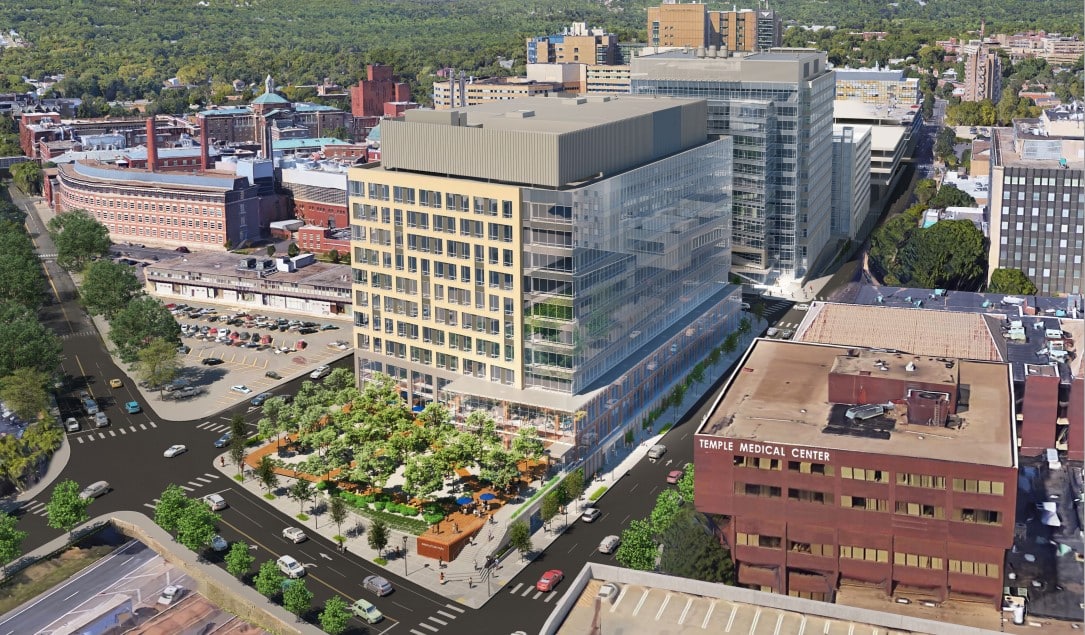
Winstanley Enterprises' 500,000-square-foot New Haven lab tower at 101 College St. Image courtesy of Elkus Manfredi Architects
New Haven and state officials joined leaders of Winstanley Enterprises last week to break ground on a pair of major, intertwined projects in the city’s downtown.
The first, a tower at 101 College St., promises to bring hundreds of thousands of square feet of much-needed new lab space to the city’s growing life sciences sector. Being developed by Winstanley, the 10-story structure will count Yale University and startup drug-maker Arvinas as its anchor tenants. The building will also house incubator space crucial to developing more home-grown life science companies as they spin off of Yale and Yale New Haven Medical Center, potentially fueling more life science development in and around the city.
The Winstanley project is just one of several life science real estate developments sprouting in the city as biotech becomes one of the hottest growth industries in the country and an area of intense real estate investor interest.
“The site will include the headquarters of Arvinas, new research laboratories for Yale University and BioLabs, which will operate the largest co-working laboratory and technology space in the state,” Winstanley Enterprises principal Carter Winstanley said in a statement. “In addition to our ongoing commitment to local hiring in construction, we will continue to make connections to this industry through the BioPath, a new STEM classroom for New Haven high school students, and workforce opportunities with New Haven Works. We look forward to this project setting a new precedent for collaboration between public and private industry.”
The second project celebrated last week was the third phase of a major rebuild of New Haven’s infamous Route 34 “highway to nowhere,” an extension of Interstate 95 plowed through one of the city’s majority-Black neighborhoods after World War II in an effort to prevent city businesses from fleeing to the suburbs by offering faster car connections between those growing communities and downtown.
Called “Downtown Crossing” or “DTX,” for short, the project will reconnect New Haven’s Temple Street to Congress Avenue with pedestrian- and bicycle-friendly streetscapes designed for slower-speed car and truck traffic. The project is key to creating a buildable parcel for the Winstanley tower on what was once the highways’ right-of-way. The project also connects the rest of the city to the Union Station Metro-North and Amtrak hub and new apartment developments in New Haven’s Hill-to-Downtown neighborhood with the city’s main jobs center.
“I want to thank city staff and elected officials and our public and private partners for helping New Haven reach this pivotal milestone in the Downtown Crossing project,” Mayor Justin Elicker said in a statement. “Together, we’ve removed what was long called the “Highway to Nowhere” and started on a path to a better future for New Haven. With the construction of 101 College Street, we’re moving towards an expanded city tax base, approximately 700 to 1000 new jobs on site and an expected spur of 3,000 jobs throughout the local economy.”
Work on Phase 1 of Downtown Crossing began in 2013 with the removal and replacement of the expressway with urban boulevards and the addition of pedestrian and bicycle amenities to College Street. The approximately mile-long stretch of highway had been called the Oak Street Connector, a reference to the neighborhood torn down in the late 1950s to make way for the expressway. Initial plans called for the expressway to extend west into neighboring towns, but the plan was later abandoned.
DTX Phase 3 infrastructure work is expected to run through the end of 2021. 101 College Street is scheduled to be completed in the summer of 2023. The fourth and final phase of infrastructure work has not yet been finalized.

