




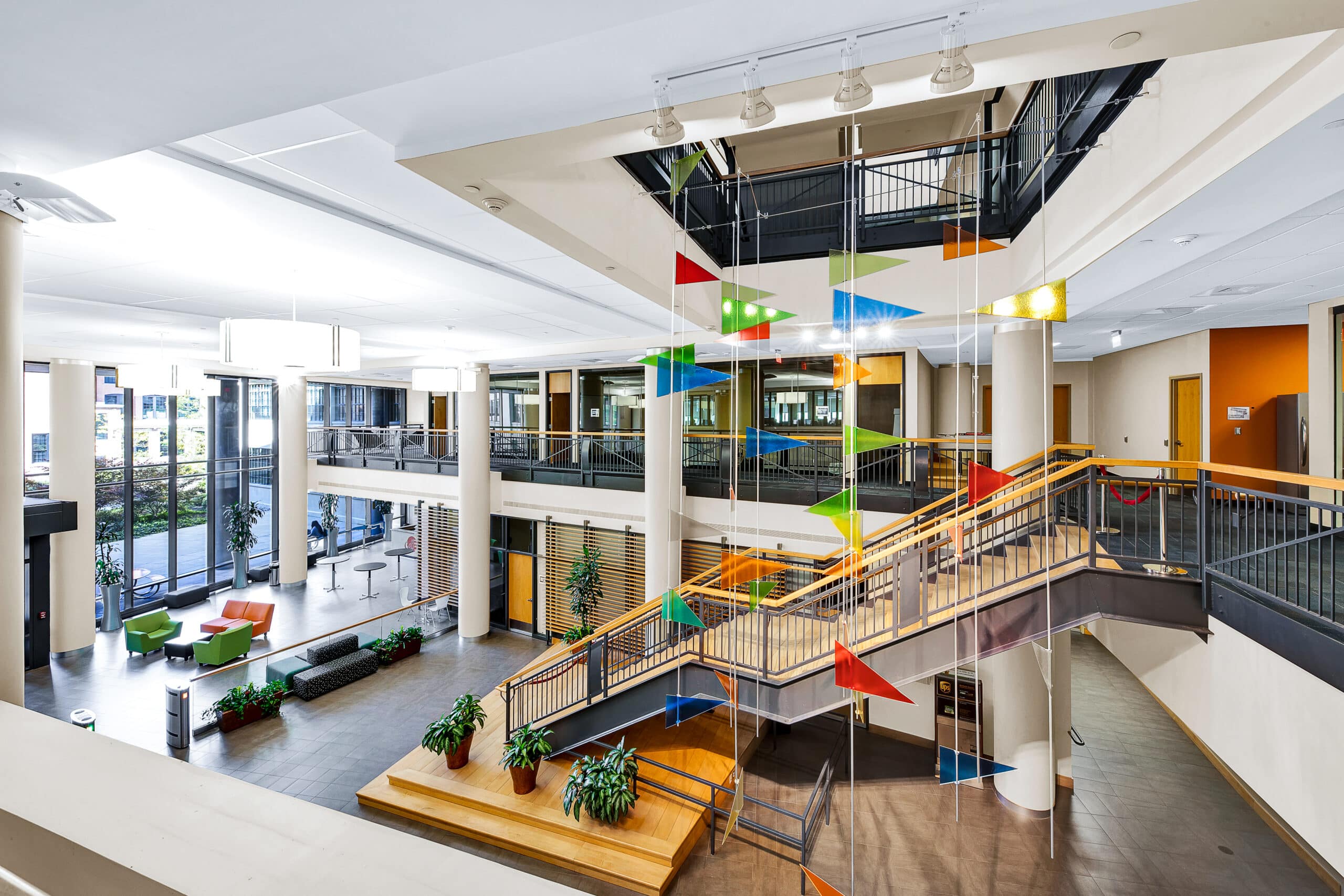
Conversion of the former Higher One headquarters in New Haven to lab-ready space by a development team including Twining Properties illustrated rising demand for life science expansion and commercial real estate opportunities in the Elm City. Photo courtesy of Twining Properties
COVID-driven disruptions to shopping and spending patterns increased pressure on Connecticut shopping mall landlords in 2020, while adding demand for warehouse and distribution facilities.
The pandemic accelerated commercial real estate trends including the declining demand for brick-and-mortar space and voracious appetite for e-commerce distribution centers.
“Developers are always going to find a way to make money and pursue work,” said Robert Pulito, president of Glastonbury-based architects S/L/A/M Collaborative. “In an era where there’s big upheaval, there are real estate opportunities and they are going after it.”
The shifting demand is prompting shopping mall owners to propose multifamily housing on unused sections of their properties and replace departed anchor stores with distribution space and medical clinics, Pulito noted.
In Trumbull, owner Westfield won approval for 260 apartments in four buildings on a parcel located between its Westfield Trumbull mall and Main Street. Connecticut Post Mall owner Centennial Real Estate proposed 300 apartments on a section of the Milford property’s parking lot, but the town’s planning and zoning board rejected a proposed zoning amendment allowing the residential use.
Maryland-based Federal Realty Investment Trust is in the midst of a partial redevelopment of its Commons at Darien shopping center following the closure of a Stop & Shop Supermarket. Scheduled for completion in early 2022, the project is adding 122 apartments in two buildings.
And logistics company Filogic Hubs said it would open a “micro distribution hubs” at the Stamford Town Center, which was sold in October to home furnishings vendor Safavieh. The Long Island retailer plans to continue operating the 520,000-square-foot retail center and opened one of its new concept stores, Safavieh Express, at the property in early December.
Amazon’s continuing need for warehouse and last-mile distribution space propelled a series of projects near the Interstate-91 corridor. The e-commerce leader is seeking to convert an industrial building at 600-100 Helmsford Way in Windsor into a last-mile distribution facility. The project would augment an existing 1.2-million-square-foot warehouse in the community and an 832,000-square-foot fulfillment center proposed by Scannell Properties. The e-commerce giant also signed on as tenant of a 403,000-square-foot distribution center built by Scannell Properties at 120 County Line Drive in Cromwell.
New Haven Seeks to Lure Biotech
Predictions that New Haven’s life science industry was poised to expand were confirmed in 2020 as developers made progress on lab conversions designed to attract startups including those led by Yale School of Medicine researchers.
Halda Therapeutics signed on as the first tenant at Winchester Works, a joint venture of New York-based Twining Properties, L+M Development Partners and Goldman Sachs Urban Investment Group. The year-old project converted a portion of the Winchester Firearms factory – most recently occupied by the Higher One headquarters – into 90,000 square feet of life science office and lab space.
At 101 College St., Winstanley Enterprises received approval in July to build a 500,000-square-foot life science building on a state-owned parcel steps from Alexion Pharmaceuticals, Yale School of Public Health and Yale School of Medicine.
And The Hurley Group, owners of 55 Church St. in downtown New Haven, received approval from the Zoning Board of Appeals to convert the 100,000-square-foot office space into biotech research space.
Hartford Ballpark Has New Neighbor
A Stamford developer launched the first phase of the $200-million DoNo development next to Hartford’s Dunkin’ Donuts Park, a project that could bring 1,000 apartments and a grocery store to the neighborhood.
RMS Cos. broke ground in October on a 270-unit multifamily building at Trumbull and Main streets, one of four city-owned parcels designated for the development. City and regional economic development officials focused on the site because of the potential spinoff development from the opening of the Hartford Yard Goats’ minor-league baseball stadium in 2017.
Developer Randy Salvatore credited the Capital Region Development Authority’s support of the $56 million initial phase, including nearly $12 million in financing, for bridging gaps between project costs and projected rents, enabling the project to break ground.

